
In our previous blog, we explored how open-source tools are reshaping test automation by offering flexibility, scalability, and cost efficiency. However, automation alone isn’t enough. Software must perform reliably under pressure and adapt with minimal disruption to consistently deliver value.
This is where application performance monitoring (APM) and site reliability engineering (SRE) become essential components of modern quality engineering. They shift organizations from reactive testing to proactive oversight, ensuring sustained quality in complex, demanding environments.
When users rely on applications to fulfill business needs, performance becomes a direct driver of success. APM provides visibility into how applications behave, detects anomalies, and helps prevent performance degradation before it affects end users. Suffice to say, it is critical for every organization to deliver and maintain top-level end user experience.
Unfortunately, manual monitoring cannot be scaled to meet the demands of today’s digital environments. Applications need 24/7 oversight, especially those involving high data volume or distributed architecture. Downtime or lag can lead to a flurry of escalations and service desk tickets, reducing productivity and eroding user trust. Large-scale data systems require real-time monitoring to prevent failures and ensure uninterrupted operations.
Automated performance monitoring provides real-time visibility and helps prevent disruptions or outages by identifying patterns like recurring shutdowns or suboptimal ERP performance. It helps organizations:
| Aspect | Manual Performance Monitoring | Automated Performance Monitoring |
| Monitoring Coverage | Limited and inconsistent | Comprehensive and continuous |
| Response Time | Slow; delayed issue resolution | Fast; near-instant alerts |
| Accuracy | Prone to human error | High; consistent and repeatable |
| Scalability | Difficult to scale | Easily scalable |
| Resource Requirement | High; requires continuous manual effort | Low; runs with minimal oversight |
| Proactive Issue Detection | Low; often reactive | High; detects issues early |
| Real-time Alerts | Not available | Available and configurable |
| Cost Over Time | High due to labor costs | Lower long-term cost |
The market offers a wide range of commercial and open-source performance monitoring tools. However, choosing the right tool is crucial for maximizing ROI.
Starting with an open-source solution allows teams to evaluate core capabilities and assess how well the tool meets their needs before committing to more advanced platforms.
However, open-source tools may lack certain enterprise-grade features such as real-time mobile alerts, automated incident creation, and reactive actions triggered by specific performance issues. These limitations have contributed to the rise of Site Reliability Engineering — a discipline focused on bridging these gaps through automation and system resilience.
SRE applies engineering principles to IT operations, blending the expertise of development and operations to create systems that are both scalable and reliable. It is built on a more than a century-old management principle that “people who create something should be equally responsible for ensuring its continued success”.
SRE is not a replacement for DevOps. It complements it. While DevOps focuses on accelerating delivery, SRE emphasizes reliability, observability, and automation. Simply put, it is effectively a more proactive form of quality engineering.
Site reliability engineers focus full-time on building software that enhances system reliability in production, including:
Instead of relying solely on reactive operations, SRE practices proactively stabilize systems, helping prevent incidents before they occur.
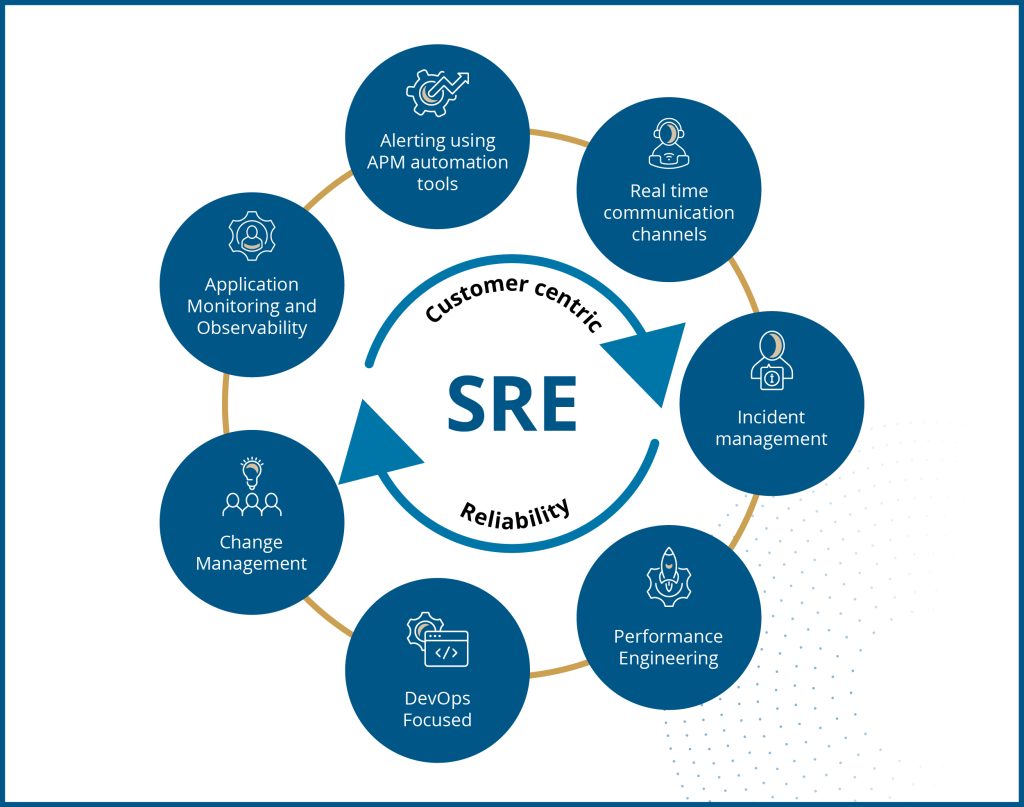
Integrating SRE into DevOps strengthens collaboration, boosts software quality, and ensures reliable performance. By understanding application behavior, SRE aligns teams, processes, and infrastructure to reduce risk, maximize uptime, and improve end user experience.
Large organizations such as LinkedIn, Microsoft, Apple, and Facebook have embraced SRE as a core component of their technology strategy. As adoption grows, SRE helps transform how teams view operations. No longer seen as reactive support, operations become a proactive force in maintaining product excellence.
At Celsior, we help clients design and implement scalable performance monitoring and SRE strategies that are aligned with their unique application ecosystems. We deliver tailored monitoring and intelligent test automation to reduce downtime, enhance reliability, and improve visibility.
This last blog brings us to the close of our QE blog series, where we’ve explored critical facets from automation to performance engineering. Each topic underscored the importance of building scalable, intelligent, and future-ready quality practices. To elevate your QE strategy, connect with Celsior and start transforming quality into a business driver.

Most insurtech was built for enterprise carriers. Here's the practical guide for small insurance carriers who need modern technology — without the enterprise complexity.
Learn More
Most insurers run underwriting, claims, and IT in silos. This post explains why that's become unsustainable and how a unified platform layer solves it.
Learn More
As Guidewire programs shift to cloud and continuous delivery, traditional staffing models fall short. Explore how AI-driven quality engineering and automation bridge the gap between strategy and execution to ensure long-term velocity and success.
Learn More
Discover how ServiceNow helps financial institutions automate compliance, strengthen IT resilience, and unify service delivery. Learn how Celsior's implementation approach brings it all together.
Learn More